
Birding and Rwanda Safari Guides
Birding in Rwanda: Where to Go and What to Expect
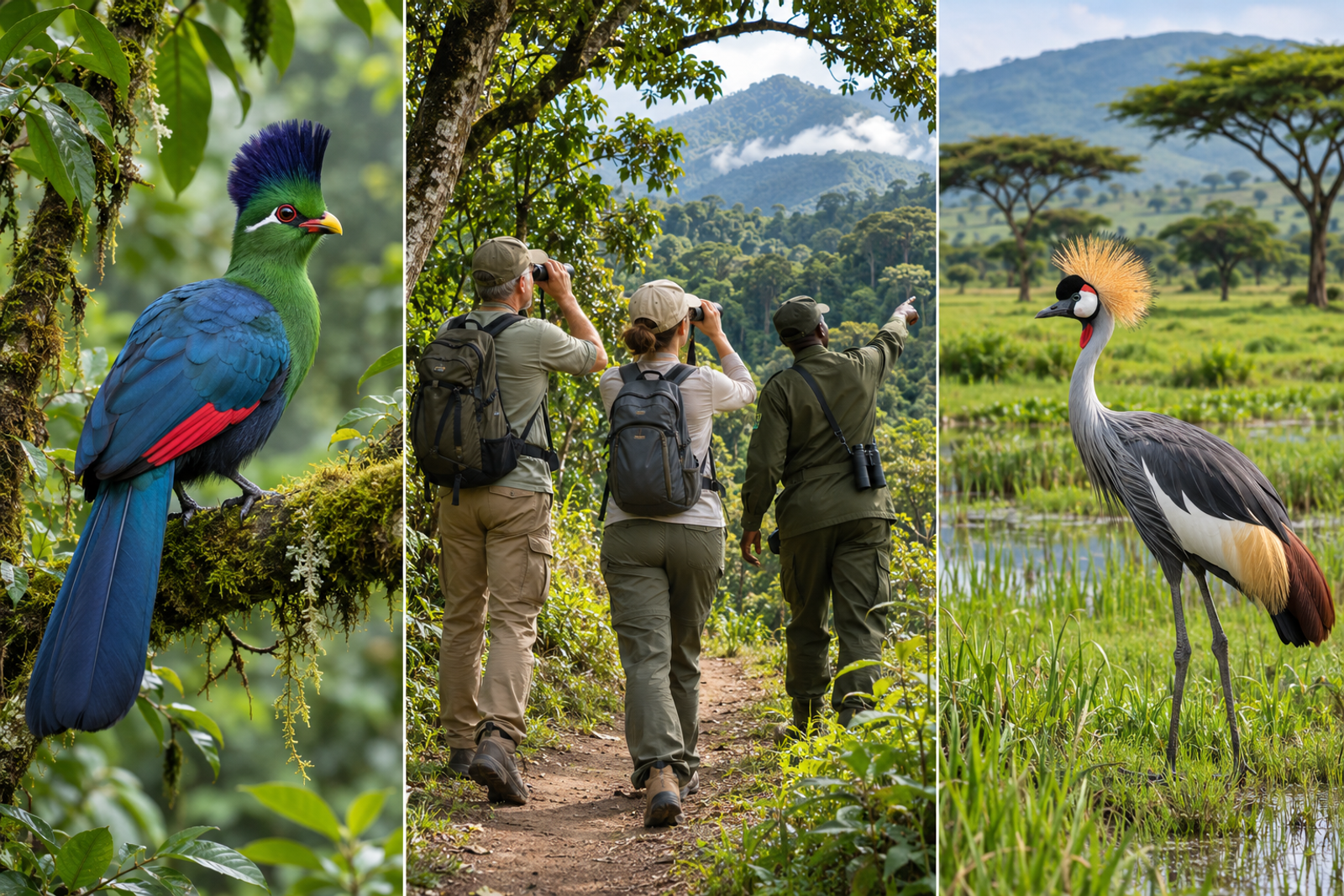
Explore birding in Rwanda through Nyungwe’s mountain forests, Akagera’s savannah and wetlands, and the shores of Lake Kivu. Discover how to choose your destinations, prepare for guided outings and combine birdwatching with primates, wildlife and community experiences
Birding in Rwanda: Where to Go and What to Expect
Birding in Rwanda brings together mountain forests, papyrus wetlands, savannah and lakeshores. These contrasting habitats make it possible to build a varied birdwatching holiday while including chimpanzee trekking, gorilla experiences, wildlife drives and locally hosted community activities.
The most rewarding itinerary depends on your interests. A first-time birdwatcher may enjoy relaxed outings alongside a general safari, while an experienced birder may want specialist guiding, target species and several mornings in the same habitat.
At Phenom Tours and Travel, our focus connects birding, primates, wildlife and community safaris. This guide explains where to go, how the experiences differ and what to consider before booking.
Explore our Rwanda and East Africa destinations for an introduction to the places you can include.
Why Choose Rwanda for a Birding Safari?
Rwanda allows travellers to combine different birding environments within one country. Instead of repeating the same type of outing, you can move between forest trails, open landscapes and waterside habitats.
Nyungwe and Akagera make a particularly useful combination. The former introduces forest birding, while the latter adds savannah and wetland opportunities.
Other destinations can complement these main stops, depending on your route and available time.
The official Visit Rwanda birdwatching guide identifies Nyungwe and Akagera as important birding destinations and describes additional opportunities around Volcanoes, Lake Kivu and Rwanda’s wetlands.
Where to Go Birding in Rwanda
Choose destinations for their habitats and how they fit your journey. Visiting more places does not automatically produce a better experience if each receives too little time.
Destination
Birding environment
Suggested role in your itinerary
Nyungwe National Park
Montane forest
A main destination for dedicated forest birding
Akagera National Park
Savannah, woodland, lakes and wetlands
A main destination combining birds and wildlife
Volcanoes area
Mountain and forest habitats
An addition to a primate-focused journey
Lake Kivu
Lakeshores and gardens
A gentler stop between active destinations
Selected wetlands
Papyrus and waterside habitats
A specialist extension arranged around access
Nyungwe National Park: Forest Birding
Nyungwe is a strong choice for travellers interested in montane forest birds and Albertine Rift species. The park’s official website highlights its regional endemics alongside its wider biodiversity.
Forest birding often requires patient listening and observation. A bird may remain hidden even when it calls nearby, and dense foliage can make photography challenging.
Allow your guide time to work through promising areas rather than measuring success only by distance walked.
Read the official Nyungwe National Park information before selecting your activities.
Birds to Discuss With Your Nyungwe Guide
Possible interests include Red-collared Babbler, Rwenzori Turaco and Regal Sunbird. Share your target list before booking so your guide can discuss suitable habitats and realistic expectations.
A record of a species in the park does not guarantee a sighting during your visit.
How Much Time Should You Give Nyungwe?
As a planning recommendation, consider several nights if forest birding is a main purpose of your journey.
One morning may provide an introduction, but additional outings create flexibility if weather or bird activity affects the first attempt.
Akagera National Park: Savannah and Wetland Birding
Akagera complements Nyungwe with open landscapes and water-associated habitats. It also offers wildlife drives and Lake Ihema boat excursions, making it useful for travellers with mixed interests.
Birdwatching can form part of a general drive, but specialist outings need a different pace. Explain whether you want frequent identification stops or a broader balance of birds and mammals.
The official Akagera website provides information about the park and its visitor experiences.
Birds to Discuss With Your Akagera Guide
Target interests may include Red-faced Barbet, Papyrus Gonolek and Grey Crowned Crane. The suitability of particular areas depends on access, conditions and the species you hope to observe.
Add a Lake Ihema Boat Excursion
A boat trip changes your viewpoint and adds variety to vehicle-based birding. Ask whether the excursion is shared or private, how long it lasts and whether its format suits specialist birdwatching.
Our 3-Day Akagera Wildlife and Big Five Safari provides a starting option for combining wildlife viewing with birdwatching.
Volcanoes National Park and Surroundings
The Volcanoes area can add mountain birding to a journey built around gorillas or golden monkeys.
However, primate tracking and specialist birding have different objectives. If birds are important, discuss a separate suitable outing rather than expecting a trekking activity to provide dedicated birding time.
Explore our 4-Day Rwanda Gorilla, Golden Monkey and Lake Kivu Safari as a starting point for a primate-focused visit.
Lake Kivu: A Gentler Birdwatching Stop
Lake Kivu can introduce lakeshore birding between more active destinations. Pied Kingfishers and White-breasted Cormorants are among the birds associated with the lake.
A lakeside stay can suit travellers who enjoy shorter outings, garden birdwatching and additional rest time.
Choose the overnight location according to the wider itinerary. Not every lakeside property provides the same access or viewing opportunities.
Wetland Birding Extensions
Wetlands such as Rugezi and areas around Bugesera can be considered for a specialist route.
Confirm access and local arrangements before including them. Avoid treating a wetland shown on a map as an automatically accessible visitor site.
For the destinations and example species above, consult Visit Rwanda’s birdwatching information.
What to Expect on a Guided Birding Outing
A birding excursion usually involves more stopping and listening than a general sightseeing walk.
Your guide may ask the group to pause, wait quietly or look through a particular opening in the vegetation. Remaining patient gives everyone a better chance to observe the bird.
A Different Pace From a General Safari
A wildlife drive may continue once the group has seen an animal clearly. Birdwatchers may need longer to locate a small bird, identify its features or distinguish it from a similar species.
Agree on the day’s priorities before setting out, especially in a mixed-interest group.
Observation and Photography Are Different Goals
Seeing a bird does not always mean photographing it clearly. Forest light, vegetation and movement can make a good observation difficult to capture.
Tell your operator whether your priority is identification, photography or both. This helps shape guiding and time allocation.
Weather Can Change the Schedule
Leave flexibility for changing conditions. Avoid making one short outing your only opportunity for an important habitat.
A guide can help adjust the plan, but no itinerary can guarantee a particular bird or a fixed number of sightings.
When Should You Plan Birding in Rwanda?
Choose travel dates according to your destinations, target birds and other activities.
A specialist birding trip should not be planned only around a general safari calendar. Ask how your dates relate to the birds you hope to see, expected conditions and practical access.
For mixed-interest travel, consider both birdwatching and the demands of forest trekking.
Carry rain protection regardless of your chosen dates, and request current advice when confirming the itinerary.
How Many Days Do You Need?
The following are planning suggestions rather than fixed rules.
Available time
Suggested approach
1 day
A focused outing near your existing overnight location
3–4 days
One main birding destination
5–7 days
A focused trip, with careful consideration of transfer time
8–10 days
Nyungwe and Akagera, with flexibility for other interests
11 days or more
Additional habitats, repeat outings and specialist targets
Experienced birders should share their target list before choosing the duration. Extra time in a productive habitat may be more valuable than adding another distant stop.
Suggested 8-Day Birding in Rwanda Itinerary
This example prioritises Nyungwe and Akagera. It should be adjusted around flights, accommodation, access and guiding arrangements.
Day 1: Arrive in Kigali
Transfer to your accommodation and settle in.
A short local outing may be considered if your arrival time permits, but avoid planning an essential activity immediately after a long flight.
Suggested overnight: Kigali.
Day 2: Travel to Nyungwe
Travel towards Nyungwe with suitable breaks.
Include birding stops only where safe and practical. Do not treat roadside stops as a substitute for dedicated time at the main destination.
Suggested overnight: Nyungwe area.
Day 3: Dedicated Nyungwe Birding
Explore suitable forest habitats with your guide.
Set the pace around observation and your interests, allowing time to listen and wait.
Suggested overnight: Nyungwe area.
Day 4: A Second Forest Birding Day
Use another outing to explore different suitable areas or revisit priorities.
Travellers wishing to include chimpanzee tracking should consider extending the stay rather than replacing all dedicated birding time.
Suggested overnight: Nyungwe area.
Day 5: Return Towards Kigali
Treat this primarily as a transfer day, with appropriate breaks.
An optional cultural visit can be considered where it fits comfortably.
Suggested overnight: Kigali.
Day 6: Travel to Akagera
Continue to Akagera and begin exploring according to your arrival time.
Discuss how to balance birdwatching with general wildlife viewing.
Suggested overnight: Akagera area.
Day 7: Akagera Birding and Lake Ihema
Explore suitable habitats by vehicle and add a boat excursion if booked.
Coordinate activity times in advance rather than assuming every option can fit into one day.
Suggested overnight: Akagera area.
Day 8: Return to Kigali
Return according to your departure arrangements.
Include a morning outing only where enough time remains for the transfer and airport procedures. An early flight may require an additional Kigali overnight.
Combine Birding With Primates and Community Experiences
Birdwatching can be the main focus of your holiday or one part of a broader safari.
Birding and Chimpanzees
Add chimpanzee tracking during a Nyungwe stay, with separate time for each activity.
Birding and Gorillas
Extend the itinerary to the Volcanoes area if gorilla trekking is a priority. Account for permits, additional transfers and overnight stays.
Our 6-Day Ultimate Rwanda Gorilla, Chimpanzee and Wildlife Safari offers a general safari framework that can be discussed for extension.
Birding and Community Visits
A locally hosted coffee, farming or craft experience can provide a different perspective between outings.
Arrange visits in advance and give hosts enough time to share their knowledge. Ask permission before photographing people.
Budget, Midrange and Luxury Birding Safaris
Accommodation level is one part of the cost. Specialist guiding, transport, park access, activity bookings and the number of travellers also matter.
Budget options can use simpler accommodation while retaining dedicated birding time.
Midrange options can balance comfort, location and cost.
Luxury options may provide higher-category accommodation and additional services, but they do not guarantee different sightings.
For a birding-focused trip, compare guide expertise, habitat access and time allocation as carefully as room standards.
What to Ask Before Booking
Request clear answers to these questions:
- Will the guide be dedicated to birding or leading a general safari?
- How many full birding outings does the itinerary provide?
- Which habitats will the route cover?
- Are park access, local guiding and boat excursions included?
- Does accommodation allow practical access to the planned activities?
- Can the schedule adapt to weather and bird activity?
- How will a mixed-interest group balance its priorities?
- What costs remain outside the quotation?
Named accommodation and clearly identified activities make comparisons easier.
What to Pack for Birding in Rwanda
Bring binoculars you are comfortable using for extended periods.
Other useful items include suitable walking footwear, rain protection, a warmer layer, sun protection, a day bag and a notebook or digital checklist.
Photographers should carry spare batteries, memory cards and protection from rain and dust.
Discuss heavy equipment with your operator. A long lens may suit some outings but become tiring on extended forest walks.
Responsible Birdwatching
Observe birds without disturbing their behaviour.
Follow your guide’s instructions, stay on permitted routes and avoid approaching nests or roosts for a closer photograph.
Do not use playback unless permitted and considered appropriate by the guide. Keep voices low and give other people space to observe.
Support conservation by respecting access rules and paying the required fees.
Frequently Asked Questions About Birding in Rwanda
Is Rwanda suitable for a birdwatching holiday?
Yes. Its forest, wetland, savannah and lakeshore habitats can support a varied itinerary.
Which destinations should I prioritise?
Nyungwe and Akagera make a useful starting combination because their habitats differ.
Is birding suitable for beginners?
Yes. Tell your guide your experience level so the pace and explanations suit you.
Can experienced birders request target species?
Yes. Share your list before booking so the operator can discuss suitable arrangements.
Are target species guaranteed?
No. A species being recorded at a destination does not guarantee a sighting.
Why choose Nyungwe?
It is an important forest birding destination with Albertine Rift interest.
Why choose Akagera?
It adds savannah and wetland birding alongside general wildlife viewing.
Can I combine Nyungwe and Akagera?
Yes. Allow realistic time for transfers and several focused outings.
Is Volcanoes useful for birdwatchers?
It can complement a mountain and primate-focused route.
Can I birdwatch around Lake Kivu?
Yes, where suitable lakeshore or garden access is available.
Can I visit wetlands outside national parks?
Selected sites can be considered, but confirm access and local arrangements first.
Can I include a short outing during a Kigali stay?
Ask about a suitable, accessible location that fits your available time.
How many days do I need?
A short trip can focus on one destination. Eight to ten days provides more scope for Nyungwe and Akagera.
Is one Nyungwe morning enough?
It can provide an introduction, but extra outings offer greater flexibility.
Should I hire a specialist birding guide?
Specialist guiding is advisable when birds are the main purpose of the trip.
Can a general safari guide lead birdwatching?
Guiding skills vary. Ask about bird identification experience before confirming.
Should I bring binoculars?
Yes. Do not assume equipment will be provided unless confirmed.
Is a spotting scope necessary?
It depends on your preferences and habitats. Ask whether your guide provides one.
Do I need a camera?
No. Birdwatching can be enjoyed with binoculars alone.
Can I prioritise photography?
Yes. Explain this before booking because photography can require different pacing.
Will every bird be easy to photograph?
No. Light, foliage and movement can make photography difficult.
What clothing should I bring?
Pack practical layers, rain protection and clothing suited to your booked outings.
What footwear is appropriate?
Choose comfortable footwear suitable for the walking conditions discussed with your operator.
Can rain affect birding?
Yes. Flexible schedules and additional outings can help manage changing conditions.
What is the best month for my trip?
Choose dates around your destinations, target species and other activities, with current local advice.
Should I expect early starts?
Discuss departure times with your guide. They should reflect the outing and local conditions.
How far will I walk?
Walking distances vary. Request details before choosing activities.
Can travellers with limited mobility participate?
Some arrangements may be suitable, but obtain specific access information before booking.
Can children join?
Family outings can be planned around children’s ages, interests and applicable activity rules.
Can non-birders enjoy the same safari?
Yes. Agree on a balance of wildlife, scenery, birding and rest.
Can I combine birding with chimpanzee tracking?
Yes. Reserve separate time for dedicated birdwatching.
Can I add gorilla trekking?
Yes, with confirmed permits and enough additional time for the Volcanoes area.
Can I include a Lake Ihema boat trip?
Yes, subject to booking and availability.
Is a boat excursion always a specialist birding trip?
No. Check whether the excursion’s format suits your interests.
Are community experiences available?
Locally hosted visits can be arranged where suitable activities fit the route.
Can I request a private birding safari?
Yes. Ask the quotation to specify the transport and guiding reserved for your party.
How much does birding in Rwanda cost?
The price depends on dates, duration, group size, accommodation, guiding and activities.
What should the quotation include?
It should clearly identify accommodation, meals, transport, guiding, access fees, activities and exclusions.
Should I keep a bird checklist?
It can help record observations. Discuss how the guide distinguishes sightings from birds heard only.
How do I request a birding itinerary?
Share your dates, experience level, target birds, walking preferences and accommodation choice through our contact page.
Plan Your Birding Safari With Phenom Tours and Travel
Whether you want an introduction to birdwatching or a journey shaped around specific habitats, begin with your interests and allow them to determine the route.
Browse our Rwanda safari packages, then contact Phenom Tours and Travel for a customised proposal combining birding, primates, wildlife and community experiences.
WhatsApp: +256 764 388 326
Share your preferred dates, number of travellers, birding experience and main interests so the itinerary can provide the right balance of guiding, activities and travel time.